




MUSCAT, OCT 12
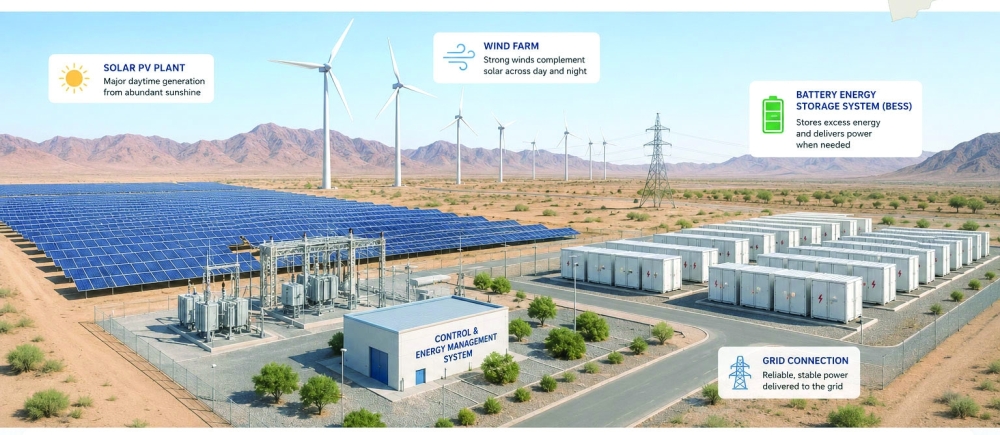
Oman Electricity Transmission Company (OETC) has outlined a grid integration schedule covering 17 renewable energy projects with a combined capacity of 7,230 megawatts (MW), alongside seven battery storage sites totaling 1,505 MW, as it expands its transmission network to meet growing electricity demand.
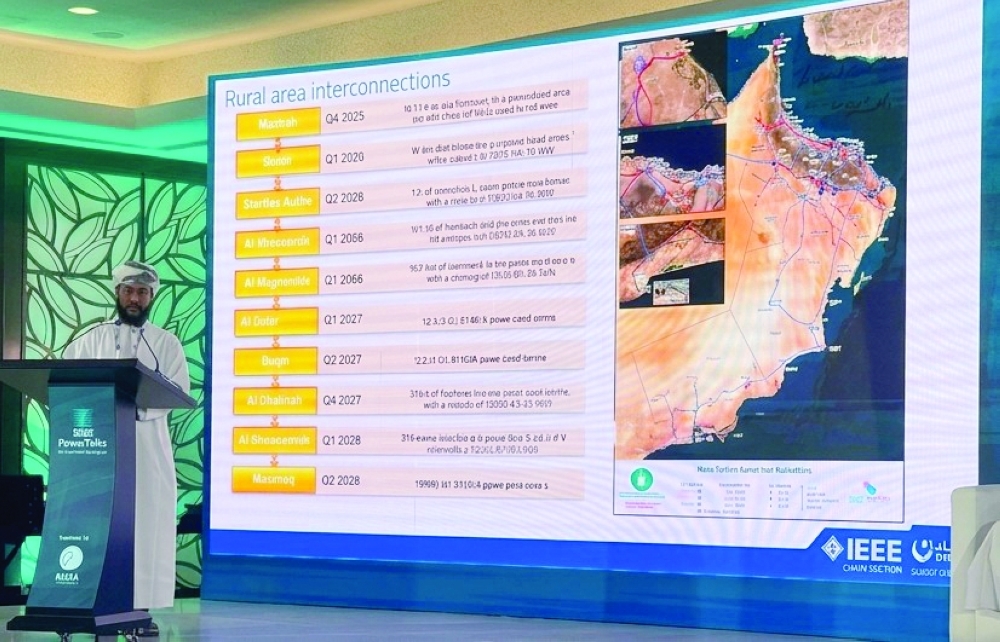
The figures were presented by Ahmed Sulaiyem al Omairi, Senior System Studies Engineer at OETC, during IEEE PowerTalks 2026 in Muscat on Monday. Spanning 2019 to 2029, the renewable schedule reflects a cumulative portfolio of existing facilities and planned connections rather than entirely new capacity.
Earlier entries include the 50 MW Dhofar wind farm, the 560 MW Ibri II solar plant, and the two 500 MW Manah solar plants. Projects scheduled for later years encompass developments across Al Kamil, Harweel, Sadah, Ras Madrakah, Sinaw, Adam, Mahout, Al Duqm, Shaleem, and Al Jazer.
Battery storage forms a distinct component of the network roadmap. OETC targets 2026 for connecting six sites with a combined capacity of 1,475 MW, followed by a 30 MW installation in Musandam scheduled for 2027. The first six sites feature a total storage capacity of 5,900 megawatt-hours (MWh), though no energy capacity was specified for Musandam.
The largest planned battery storage projects are at Ibri and Duqm, each rated at 500 MW and 2,000 MWh. Salalah is earmarked for 250 MW (1,000 MWh), with additional 100 MW installations at Al Maballa and Al Amerat, plus a 25 MW facility tied to Ibri Solar III. Target dates indicate technical integration milestones rather than commercial operation dates.
OETC projects peak system demand will grow by approximately 13.2%, rising from 9,998 MW in 2025 to 11,313 MW in 2029. Over the same period, annual electricity generation within OETC’s network is expected to expand by 27.7%, from 55,765 gigawatt-hours to 71,185 gigawatt-hours.
Al Omairi linked this expansion directly to Oman's north–south interconnection programme. The presentation outlines approximately 671 kilometers of 400-kilovolt overhead lines in Phase 1, followed by roughly 600 kilometers in Phase 2 extending from Al Duqm toward Dhofar, with strategic grid stations planned for Al Duqm, Shaleem, and Salalah.
Integrating these regional networks will help phase out reliance on diesel-fired generation, allow operators to share spinning reserves, and bolster power security—particularly in Dhofar. While lower capital and operational expenditures were highlighted as expected benefits, specific financial savings were not quantified.
Additionally, OETC’s rural interconnection schedule sets a target for Masirah Island in Q4 2026, comprising 33.5 kilometers of submarine cable and 56.2 kilometres of overhead transmission lines. Further grid extensions across central and southern Oman are planned through 2029.
At the end of 2025, OETC operated over 10,000 kilometres of power lines and 125 grid stations. Highlighting future industrial load requirements, a separate presentation slide identified up to 2,700 MW of potential demand from OQ-linked processing plants in Al Duqm and Dhofar.
Oman Observer is now on the WhatsApp channel. Click here